

17 Sep We talked AI and the public – on the red sofa


Followers of Let’s Talk AI, know the importance of the red sofa to our campaign. So we were delighted when Susan appeared on the red sofa to talk to Naga and Charlie following Microsoft AI boss, Mustafa Suleyman. The conversation was dominated by recent fears from Suleyman and other AI bosses that AI was out of control.
Susan centred the ethos behind Let’s Talk AI: the importance of improving AI Awareness – and including the public in discussions around AI. Watch the full interview here and scroll down to the full transcript below.
Full transcript
 Naga Munchetty
(0:00 – 1:09)
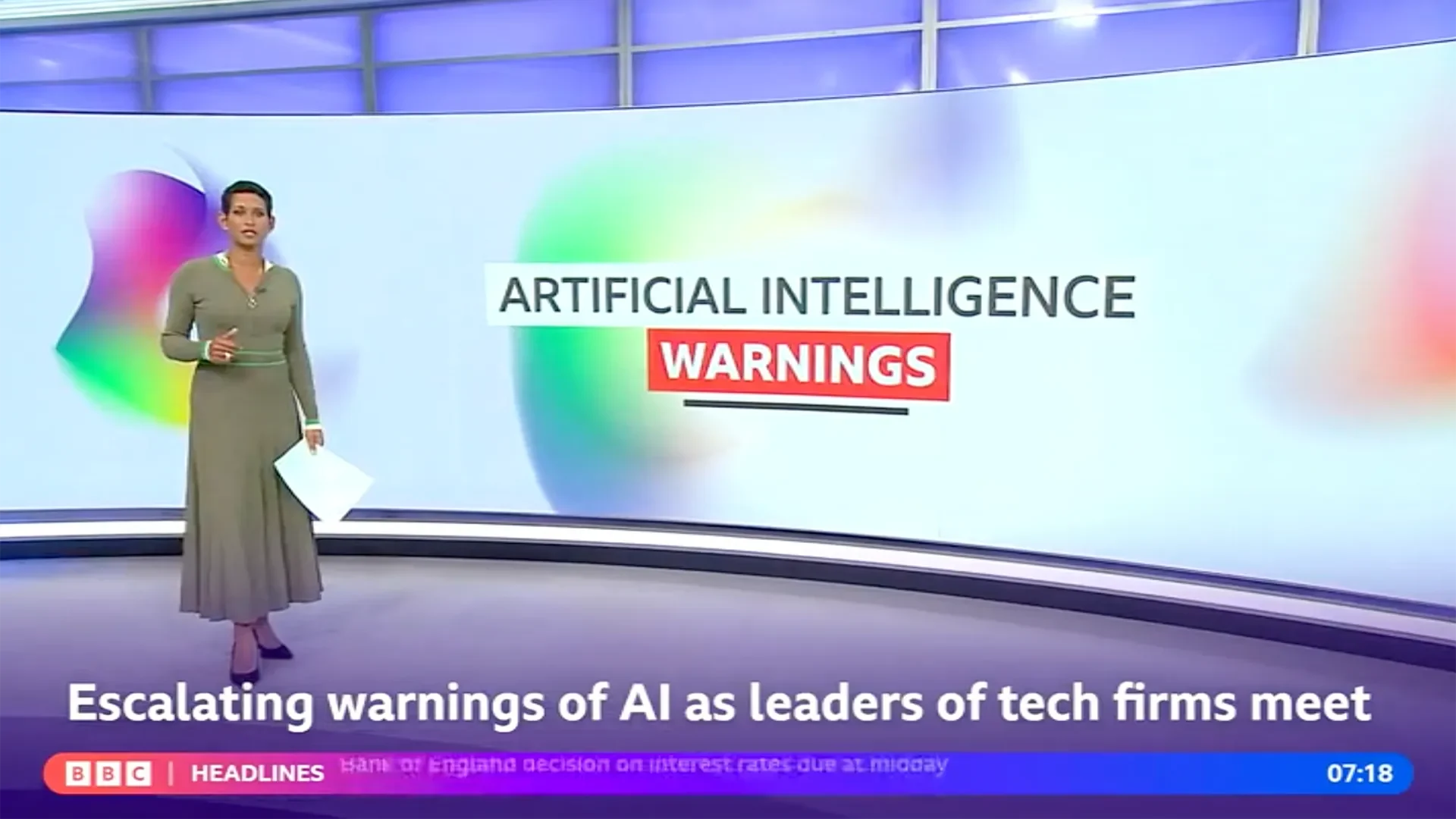
The King will today meet with leaders from the artificial intelligence industry and government to discuss the future of AI. Now, all of this comes after a series of escalating warnings in recent days and weeks from some of the industry’s biggest names.
The co-founder of Anthropic, Dario Amadei, warned that powerful AI systems could cause enormous damage if they fall beyond human control. One former employee of Anthropic said people working on the technology were frightened about the speed of its advancements and it could end humanity. Another company researcher said that there’s more than a 10% chance of the technology leading to human extinction within the next decade.
Meanwhile, OpenAI’s boss, Sam Altman, has said people are right to be afraid, but should trust firms to do the right thing and keep technology safe. Well, speaking to Radio 4’s Today programme this morning, the boss of Microsoft AI, Mustafa Suleyman, defended the industry, saying that despite concerns, there are practical safeguards that can be put in place.


 Mustafa Suleyman
(1:10 – 1:52)
If we all create AIs that are able to act autonomously, that can define their own objectives, that can earn money, that can own assets, that could run businesses, we’re essentially seeding a new silicon species which will no doubt compete with us for resources no matter how much it cares about humanity and loves us. We should be alarmed. I mean, fair enough, we should be alarmed.
These are very concerning events. We should be very worried. And I think it’s right to pay attention right now because there are very practical things that we can do to add additional guardrails and controls to how these models are developed.
 Charlie Stayt
(1:53 – 2:14)
Well, joining us here is Professor Susan Oman, who’s a senior lecturer in data and AI at University of Sheffield. Good morning to you.
Just so people understand where you’re coming from on this, you heard the alternatives, alarmed, worried, I don’t know what else, you’re terrified, blocking your ears. Where are you on that scale about what we’ve been hearing most recently?
 Dr Susan Oman
(2:14 – 2:31)
So, myself and a number of colleagues across academia and civil society have been concerned about AI for quite a long time. I think the things that we’re concerned about AI aren’t necessarily the end of humanity, which is the drama that we’re hearing unfolding in recent weeks.
Charlie Stayt
(2:31 – 2:33)
You’re not concerned about that?
Dr Susan Oman
(2:34 – 3:05)
We’re concerned about the things that we have evidence for. So what you’ve just shown are a series of clips of predictions from people who have vested interest and earn a lot of money from the production of these technologies. Crucially also, what you’ve presented are a series of quotes where people say, yeah, we kind of should be worried, but they don’t agree on the degree to which they should be worried.
The differences in what these people are saying are the things that we should be focussing on. They don’t agree because they’re all in competition with each other.
Naga Munchetty
(3:06 – 3:21)
OK, which brings us in a way to this event, sort of curated in a way by King Charles. And I think what they’ve said is they want to focus on ways that AI can benefit society, which goes slightly against the narrative we’ve just been hearing, doesn’t it?
Dr Susan Oman
(3:21 – 4:15)
Yes. And I think that this is the thing that myself and other figures from civil society that we’ve been working with are key to focus on. The key question is how can AI help us live in the society that we want to live in?
We want to understand what the general public wants from society and the AI-enabled society that we can live in. So I do think it’s important to bring together experts from technology companies and other world leaders. But the King’s Summit is not the first time that these experts have come together.
The Pope brought people together in the Vatican a few years ago. We’ve also had annual international AI impact summits for the last four years. And so bringing the great and the good together to listen to each other about what to do is all very well, but maybe we need some other voices at the table and some other people listening and some other people talking.
Naga Munchetty
(4:15 – 4:45)
And they seem to have anticipated this because they’ve already said, we can regulate ourselves, trust us. Now, when you say they’re in competition with each other, so are they all kind of putting out these comments? Yes, it could be deadly.
Yes, it is a threat because we’re so powerful and showing their might. Because when they do that, their share price is full. So I don’t understand, when you say they’re competing against each other, obviously they are, but you’d think they’d be coming together rather than admitting there would be a problem.
There could be a problem.
Dr Susan Oman
(4:45 – 5:21)
Well, they are in some ways coming together to admit there could be a problem, but the degree to which they say there is a problem differs, but also they brand themselves slightly differently. So Anthropic was set up because it would be safer than OpenAI. So of course the leader of Anthropic is going to come out five years later and say, oh, look what OpenAI did.
We are safer. We’re more concerned with safety. So, thinking about why these powerful people are saying specific things about the products that they have a vested interest in is one of the key questions.
Naga Munchetty
(5:21 – 5:48)
So what do you do? We’re in a society now where you look up a map, AI starts, is helping, obviously is part of it, and infiltrates. So it knows, it predicts things, doesn’t it?
We are using AI even when we don’t know it. People are going into a search engine and going, oh, well, AI says this. It’s not even looking then at yourself at the results.
What do people think about? What should they be mindful of now?
Dr Susan Oman
(4:45 – 5:21)
Well, actually what I hear when I speak to the general public is they want to have a better understanding of when they’re using AI and when AI is being used with them or on them. They want to understand how it’s infiltrating public services, and they want to understand how to make the right decisions about their everyday interactions with technology. There’s an awful lot of investment from the UK government in AI upskilling, but actually what we do need is a better awareness in the general public.
Charlie Stayt
(6:20 – 6:24)
So you’re an academic and you have great expertise. You’re also a human being.
Dr Susan Oman
(6:24 – 6:24)
Yes.
Charlie Stayt
(6:25 – 6:30)
So in your human being part of your life, what worries you most about AI?
Dr Susan Oman
(6:30 – 6:43)
What worries me most is what I know is happening, which are the poorest parts of society and the poorer parts of the world are the ones that are most disproportionately affected by the production of these technologies. That’s what we have evidence for.
Naga Munchetty
(6:30 – 6:43)
Can you explain that?
Dr Susan Oman
(6:44 – 7:28)
Yes. So for example, all of this AI was trained on data. That data was labelled by people from poorer parts of the world.
Those people were exploited. Those people saw horrible images that they had to label so that people in the Northern Hemisphere didn’t have to see such horrendous pornographic images. We know that the production of data centres is something that has historically disproportionately affected poorer communities.
And that’s why people in the UK are standing up and saying, we don’t want a data centre in our backyard. So I think what we know about technology that’s enabled to be developed unhindered is that historically that has always affected the poorest most.
Charlie Stayt
(7:28 – 7:52)
That is very interesting. It wasn’t quite what I meant when I asked the question. I was sort of curious about, because people are at home doing their thing today.
They’re leading their lives. What don’t you do that you might otherwise do because you’ve got AI thinking, I don’t know what AI is doing. Is there something that you, a way you go about your daily life that you have and are rethinking because of something to do with AI?
Dr Susan Oman
(7:54 – 8:55)
So I suppose the recent news won’t change the way that I use an AI-enabled technology. What I do know is that when I search the internet for something, I am more careful about assessing the source of that material, making sure that it’s from a credible news source or a credible academic. I do know that, for example, I use AI enabled technology more and more.
I have a recently disclosed disability. So I use taxi services that rely on AI. I rely on delivery services more than I ever did.
It’s about what we need as a baseline awareness of understanding what we can trust and what we can’t trust. And I think the thing is, is that that’s very complex and very difficult to explain in 30 seconds, which is why we need the general public to have more interactions and healthier conversations about what these technologies actually are, who’s producing them and the choices that they can make because not everyone feels that they can trust the governments or these tech companies.
Charlie Stayt
(8:56 – 9:07)
It’s very interesting. Dr. Susan Oman from University of Sheffield. Thank you very much.
And of course, we’ll keep an eye on what comes out of this forum. It’s happening in the next couple of days. Thank you very much.
Dr Susan Oman
(9:07 – 9:08)
Thank you.